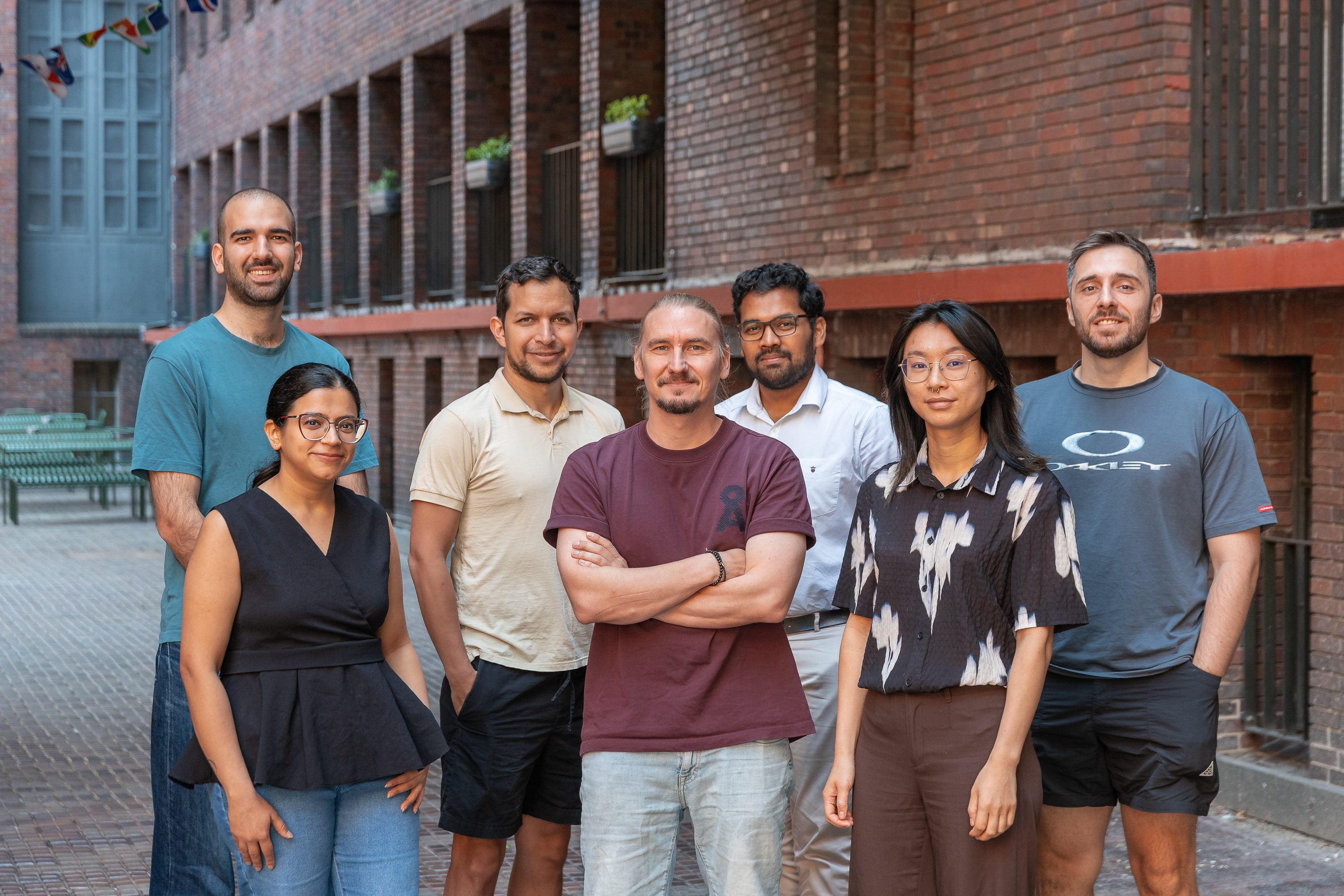
The GetYourGuide tech team in the spotlight
Discover how GetYourGuide’s tech team is driving innovation—presenting at international conferences, publishing impactful research, and sharing expertise on leading podcasts. Explore 2025’s highlights and see how our experts are shaping the future of travel technology.

Careers Team
.JPG)
Key takeaways:
Over the past year, our tech team has taken center stage at international conferences, published impactful research, and sparked conversations on podcasts. It's the perfect way to share what we’ve learned and connect with the larger tech community.
This blog post highlights some of our favorite moments when our team got the chance to shine in 2025.
Scroll down to watch, read, and hear more about it.
{{divider}}
Conferences
Dharin Shah at WeAreDevelopers
Supply Platform Engineer, Dharin, discusses how we optimized our discovery process using PostgreSQL at the WeAreDevelopers World Congress in Berlin.
Watch it here.
Synopsis
At GetYourGuide, search is split into two dynamic components: Structured and Unstructured Search. While OpenSearch and JSON offered flexibility with schemas, filtering, and aggregations, they also presented challenges — including performance bottlenecks, complex cluster management, scalability issues, and slow writes that impacted read performance.
Enter, Postgres. Its hybrid schema and innovative denormalization unlocked faster queries (40% faster!), simplified scalability, and laid a powerful foundation for limitless possibilities in our Marketplace.
This talk dives into the transformation, tradeoffs, and the game-changing impact of Postgres on our search functionality.
Mihail Douhaniaris and Theodore Meynard at PyData London
Senior Data Scientist Mihail Douhaniaris and Engineering Manager Theodore Meynard shared our journey from tree-based models to Deep Learning pipelines at PyData conferences around the globe.
Watch it here.
Synopsis
GetYourGuide, a global marketplace for travel experiences, reached diminishing returns with its XGBoost-based ranking system. We switched to a Deep Learning pipeline in just nine months, maintaining high throughput and low latency. We iterated on over 50 offline models and conducted more than 10 live A/B tests, ultimately deploying a PyTorch transformer that yielded significant gains.
In this talk, we share our phased approach — from a simple baseline to a high-impact launch — and discuss the key operational and modeling challenges we faced. Learn how to transition from tree-based methods to neural networks and unlock new possibilities for real-time ranking.
Agus Figueroa and Danny Burleigh at PyCon Wroclaw
Senior Data Analyst Agus Figueroa and Data Analyst Danny Burleigh presented a fascinating talk called ‘Trust your LLM: Statistical acceptance sampling for reliable quality measurement’ at PyCon in Wroclaw.
Watch it here.
Synopsis
In this presentation, you’ll learn how to confidently evaluate LLM outputs using statistical acceptance sampling. Discover a robust framework that determines exactly how many outputs to manually review, quantifying LLM quality at your chosen confidence level with minimal effort.
Oleksii Serhiienko at Datadog Summit Berlin
Senior Site Reliability Engineer, Oleksii Serhiienko, took to the stage to discuss how his team put database performance at the center of their monitoring strategy to streamline our Supplier Portal.
Watch it here.
Synopsis
Fast front-end and back-end code alone won’t guarantee low end-to-end latency, as hidden database bottlenecks can undermine even the best engineering efforts. Find out how we identified and fixed slow queries, uncovered load-balancing issues driving significant cost savings, and built monitoring practices that improved both reliability and investigation workflows.
Joseph El Mallah at Swift Craft
Senior iOS Engineer Joseph El Mallah presented at the Swift Craft developers conference in the UK. He discussed how and why it was beneficial to get Swift 6, Async/Await, SwiftUI, and the main thread all speaking the same language.
Watch it here.
Synopsis
This talk explores how to build a modern app that utilizes these separate technologies to their strengths. By offloading heavy work using Async/Await, securely and in compliance with Swift 6, you can achieve a highly responsive UI that never blocks the main thread.
Publications
Alexander Weiss published in the Journal of Statistical Computation and Simulation
Two and a half years in the making, Senior Data Science Manager Alexander Weiss’s academic article, “Basemath’s test: group sequential testing without recurrent numerical integration,” was recently published.
Read it here.
Synopsis
This paper introduces Basemath's Test, a new approach to running A/B experiments that’s much more efficient than traditional methods. The big idea? Stop experiments early when they’re clearly ineffective — saving tons of time and resources.
At GetYourGuide, Basemath’s Test has been the default method for running A/B tests for more than two years, cutting experiment running time by 35–40% without sacrificing statistical reliability. Since most experiments don’t show significant improvements anyway, being able to stop the losers early makes a huge difference. This method is computationally simple, easy to implement in Python or other common languages, and available as open-source software.
You can dive into the details of how Basemath accelerated A/B testing at GetYourGuide in part 1 and part 2 of this two-blog series.
About the Journal of Statistical Computation and Simulation
The Journal of Statistical Computation and Simulation (JSCS) is a peer-reviewed journal that publishes research on computational and simulation methods in statistics. "Computation" covers data analysis techniques, while "Simulation" focuses on methods like Monte Carlo simulation.
Podcasts
Usama Nasir speaking on De Nederlandse Kubernetes Podcast
Staff Engineer, Usama Nasir, delves into a topic that many teams don’t address until it’s already too late: Garbage Collection in Java microservices.
Watch it here.
Synopsis
While you might think Kubernetes solves everything, Usama explains how his team at GetYourGuide was still caught off guard by mysterious Out of Memory errors. The story? Microservices may be small, but that doesn’t mean Java’s memory management is automatic.
This episode explores how Java’s model operates, why different garbage collectors (such as G1GC or ZGC) behave significantly differently under pressure, and how subtle choices can have a profound impact on performance. Usama explains how observability with tools like Datadog proved indispensable, and why it’s sometimes smarter to allocate less memory to your containers.
But the most important insight? Garbage Collection isn’t a “Java thing.” It’s a responsibility of both developers and DevOps/SREs. Only together can you find that sweet spot between speed, stability, and scalability.
Looking ahead
As we reflect on a year of innovation, collaboration, and growth, it’s clear that our tech team’s impact reaches far beyond our office walls. By sharing our breakthroughs, we strive to contribute to the broader community and inspire other professionals in the field. Plus, it keeps us excited for what lies ahead in the future of tech and travel experiences.
We look forward to sharing more insights in 2026!
{{divider}}
Want to be a part of our team? Click here to learn more about how we bring unforgettable experiences to millions.

More articles like this
%202.JPG)
.JPG)