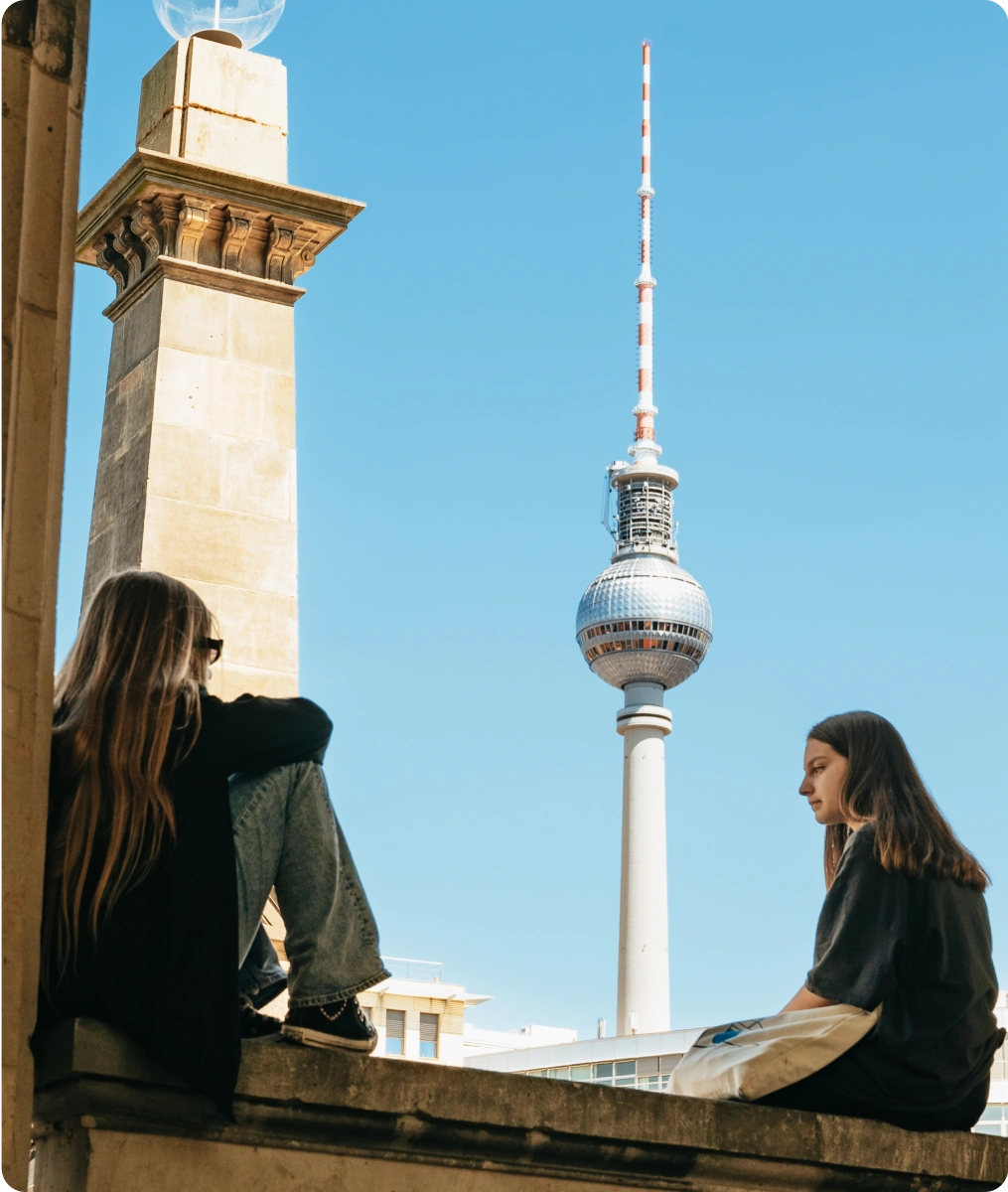
relocation
With the right help, relocating to a new city or country can be the adventure of a lifetime. That’s why we provide a comprehensive overview of support offerings and resources for making your move as smooth as possible. From visa support to navigating an exciting new culture, we have you covered.


What we offer
We offer a tiered relocation bonus based on the role level you are applying for as well as your family situation.
Please reach out to your dedicated recruiter for detailed information on your particular case.
In addition to a one-time bonus we also cover the cost of flights associated with relocation for you and your family.

We’ve partnered with Start to provide relocating employees with dedicated 1:1 support.
Depending on your role level, you’ll receive a package of consultation hours for any and all questions that pop up along your relocation journey. For example, Start can attend bureaucratic appointments with you, help you set up a bank account, or even aid in your apartment search.

Getting your permit or residence documents is the first step on your new adventure in Berlin.
As soon as you sign your contract, our HR team will get in touch to help guide you through the process step by step. Additionally, any costs related to the visa or work permit application—such as translation and foreign office fees—will be reimbursed for all positions, on top of relocation allowances.

Your temporary housing is on us.
Our relocation agency will ensure you have an initial home base while you search for a permanent residence.*
*Available for select positions. Please consult your offer details and recruiter for eligibility.
It’s quite easy to get by in Berlin without having German language skills.
However, we still offer on-site German classes in addition to reimbursement for external language classes.

Moving with children
We appreciate that there may be other people in your life to consider when thinking about relocation. Here are some of the most useful resources from our GetYourGuide parent community
Financial support for families (child benefits)
All parents in Germany are entitled to financial benefits to offset the cost of raising children. This includes a monthly stipend for children’s basic needs (“Kindergeld”), tax allowances and deductions, as well a parental allowance for the full-time caregiver (“Eltengeld”).
Finding a daycare (“KiTa”)
KiTa, or daycare, is free in Germany. But it may take some time to find the right care for your family. Here are some best practices for securing your spot:
- First, apply for your KiTa-Gutschein—a voucher that provides your child with free childcare in Berlin. Having this ahead of time often makes finding a KiTa spot faster and easier.
- Start putting together your shortlist of KiTas as early as possible. Most KiTas will have a waiting list. You can find an overview of options on the KiTa Navigator.
- Your local “Jugendamt” (Youth Welfare Office) can also help you find a KiTa.
- Visit your desired KiTa in-person first to learn more about their methods and application process.
- Applying for KiTa—there are several ways to secure your spot:
- Apply via KiTa Navigator (not every KiTa will accept applications via this portal, however).
- Apply directly through the desired KiTa’s own website (some KiTas only accept applications this way).
- Keep a running list of the KiTas you’ve applied to and follow up with them often to check on the status of your application. It can also be very useful to include more information about your family along with a photo in this email.
- KiTa enrollment - It’s important to mention that once accepted to KiTa, it is common to have an induction period (known as Eingewöhnung). During this time, a parent will attend daycare alongside their child while the child adjusts to the new environment. This process can take between 4-6 weeks
Enrolling in school
Germany offers one of the most structured and effective school systems in the world. Focusing on practical education, graduates enjoy a very high employability rate. Best of all, it’s free. Explore more about education in Berlin and get a quick summary of tips and resources below:
- The first level of school beyond KiTa is primary school, for grades 1-6. Kids are assigned to a primary school based on their registered address (parents will get a letter about applying to primary school when their child is close to 5 years of age).
- Application to primary school takes place in the Fall of the year prior to a child beginning school.
- In the 6th school year, children and their parents make a decision about the type of secondary school they wish to attend: secondary school or gymnasium.
- International schools in Berlin
Finding a doctor
Doctolib.de is a good starting point for sourcing a pediatrician—Kinderarzt) as you can filter for English speaking doctors. Once you find a suitable doctor in your area, it’s recommended to call and book an enrolment appointment. After this initial appointment, you’ll be able to walk in whenever your child isn’t feeling well.
Finding a babysitter/nanny
For additional childcare needs, we recommend the following resources:
Additional resources
- Kietzee - an online community offering free and paid for resources for expat parents in Berlin.
- The GetYourGuide Parents Community - our internal parents Slack channel (#gyg-parents) is a great way to exchange knowledge and get advice. We also offer a yearly kid’s day celebration filled with fun for all ages.
What Should I Prepare for the Interview?
When Can I Expect Feedback After the Interview Takes Place?
What Are the Next Steps in the Process?
How Can I Prepare for the Team Fit and Stakeholder Interviews?
German Bureaucracy
German bureaucracy can be tedious, but the good news is that you’re not alone. Remember, your Start Relocation coaching hours can be used for exactly these topics. Here’s a short overview of compulsory actions you’ll need to take:
Registering
Once you’ve found an apartment it is important to get registered at a town hall (Bürgeramt) as soon as possible.
If you come to Germany with a visa through GetYourGuide, you don't need to schedule an appointment at a town hall, as the foreigners office submits your documents to the town hall after your visa appointment in Berlin.
Here’s a step-by-step explanation for how to schedule an appointment at the “Bürgeramt". As appointments book up quickly, it is also ok to book an appointment several months into the future:
- Enter the following link: https://service.berlin.de/standorte/buergeraemter/
- Choose one “Bürgeramt”—you are allowed to register at any Bürgeramt in Berlin.
- Scroll down to “Angebotene Dienstleistungen” and select the type of appointment you would like to book (in this example check the box for “Anmeldung einer Wohnung”)
- On the bottom right hand side click the button “An diesem Standort einen Termin buchen”.
- The available dates are marked in blue. If there are no available dates at your selected location, you can try another office or simply check at different times during the day (new appointments tend to be published in the morning between 6:00 and 8:00 am). If you need help scheduling an appointment, let us know.
Documents you should bring to the appointment:
- Valid Passport
- Application form (Anmeldung bei der Meldebehörde)
- Rental contract/proof of residency (Einzugsbestätigung des Wohnungsgebers des Vermieters). You can find that here (please check the 1st and 3rd form at "Formulare" this form needs to be signed by your landlord/renter).
After completing your registration, you will receive your Tax ID (Steueridentifikationsnummer) within a couple of weeks via post—please make sure that your name is on the mailbox to ensure you receive it (TIP: request that your landlord do this for you upon moving it). This document is very important and we recommend storing it in your personal files as you will need it for future bureaucratic actions.
Opening a bank account
Setting up a bank account is a straightforward process. Make sure to bring along your passport and money for the initial deposit.
You may also have to show your “Meldebescheinigung,” the proof of your registration in Berlin. Some banks may even require your employment contract.
The most common account is called a Girokonto which is basically a checking or debit account. Once you have opened an account, the bank will issue your “EC-Karte.” You can use this card at Geldautomaten (ATMs) and at various shops and restaurants that accept card payment.
The largest banks in Germany are Deutsche Bank, Commerzbank, Postbank, and Hypovereinsbank. Other popular banks include Sparkasse and Volksbank. A basic checking account should be enough for most of your everyday banking needs. However, if you are looking for additional benefits, you may need to choose a premium account and pay a monthly fee. You may also be interested in the convenience of an online bank such as N26 or Comdirect.
Signing up for health insurance
According to social security law, anyone employed in Germany must be registered for German health insurance from the very first day of their employment.
Employees with an annual income over 69,300€ gross (2024) might consider private health insurance (Private Krankenversicherung). If you are interested in this option, please contact a broker as companies are not allowed to provide this service.
Other employees must register at a public health insurance provider (Gesetzliche Krankenkasse). We suggest enrolling with one of the biggest in Germany like Techniker Krankenkasse, Barmer GEK, AOK, or DAK, which you can register for online. At Barmer and TK we have our English-speaking agents who provide service for our employees and can assist you with the signing up process. Simply send them an email with your filled-out application and state your start date at GetYourGuide.
- Registering with Barmer: please send an email to Conrad Winter (conrad.winter@barmer.de)
- Registering with TK: please send and email to Simone Taisakowski (Simone.Taisakowski@tk.de)
Some weeks after your registration, you’ll receive a letter via post stating your Social Security Number (“Sozialversicherungsnummer”) as well as your electronic health card (“elektronische Gesundheitskarte”), which proves that you are insured by a German health insurance provider. You’ll need this card whenever attending a doctor’s appointment.
Contributions:
Statutory health insurance contributions are dependent on income. The basis is the total gross income, from which a uniform contribution rate of 14.6% is levied. The costs are split evenly between you and your employer, which comes out to 7.3% each. All payments are processed via payroll and are listed on your monthly payslips.
Statutory health insurance allows children and spouses to also be insured free of charge with a family insurance policy.
Social Security and Pension in Germany
In Germany, all workers contribute to the social security system. This statutory system ensures that all people are taken care of in the event of sickness, unemployment, and retirement.
A few considerations about this complex topic:
- Sick leave - there are unlimited sick days in Germany. GetYourGuide also offers five days of sick child leave (paid) as an additional benefit.
- Pension insurance - if you move out of the EU at some point in the future, there is still an option to refund your pension contributions or receive a German pension at the age of retirement.
- Unemployment - the German government offers unemployment benefits to anyone without work.