How Data Analytics has shifted with the rise of AI: Your future is about ownership, not output
Learn how AI is reshaping the data analyst role at GetYourGuide—from automating technical tasks to elevating business ownership, context, and accountability in analytics.

.JPG)
Key takeaways:
With AI, coding is faster than ever. Our SQL writes itself, pipelines that used to take days now take hours, and dashboards appear before the meeting ends. You’d be forgiven for thinking that data analysts should be running out of work.
Instead, the team at GetYourGuide has never had more of it.
In this post, we’ll break down what AI is speeding up first, what it still struggles with, and what that means for Data Analysts. If you’re interviewing for an analytics role, you’ll also see the skills we think matter more now than they did two years (even months) ago.
{{divider}}
The old workflow
A typical analytical project moves through five steps:
- Ask (analyst & stakeholder) — Define the business question or problem and align with your relevant stakeholders.
- Prep (analysis) — Collect, clean, and validate the data.
- Analyze (analysis) — Explore patterns, trends, and drivers, and validate.
- Communicate (to stakeholders) — Visualize insights and recommend actions.
- Monitor (stakeholder) — Track outcomes and iterate.
Two things stand out about this workflow. First, at GetYourGuide, the analyst usually drives it: Projects rarely start with a ticket landing on our desk; more often, the analyst spots the business problem, brings it to stakeholders, and aligns on whether and how to tackle it.
Second, the steps demand very different skills. The stakeholder-facing work at the start and end of the workflow often requires communication, domain knowledge, and critical thinking to identify the right problem, understand it thoroughly, and challenge the plan when needed. The analysis in between calls for technical and statistical depth: collecting, cleaning, and analyzing data with the appropriate methods.
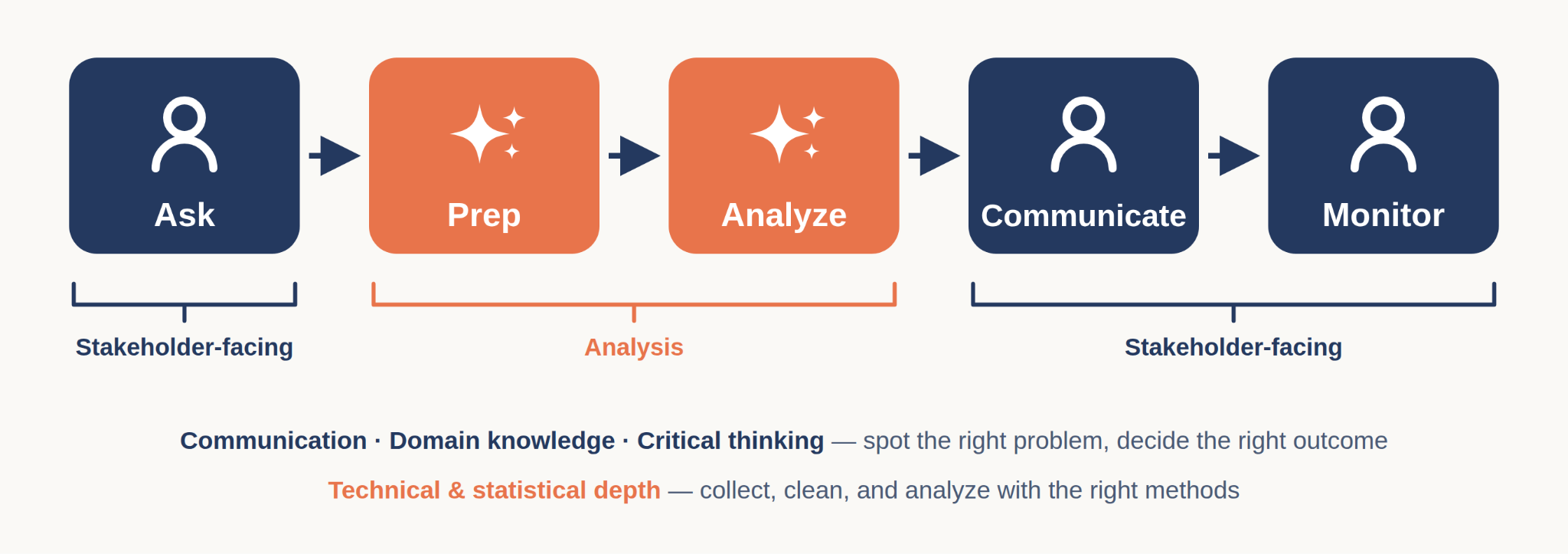
AI is now compressing this workflow in exactly the ways you’d expect. The surprising part is what that compression does to the job: faster analysis hasn’t led to less work.
What AI accelerates first
So far, AI performs strongest in the middle of the workflow: Prep and Analyze. It can speed up:
- Writing and iterating on SQL
- Cleaning and reshaping data
- Exploring unfamiliar tables and systems
- Drafting charts and summaries
What it struggles with (at least in a reliable way):
- Picking the right question in the first place
- Knowing what context matters to our business
- Being accountable for an answer, not just producing output
When more people can create “analysis-shaped” work, it drastically increases the need for review, interpretation, and decision support.
The bigger shift: the world around analytics sped up
When every team around you is working more efficiently than ever before, you have to stay sharp and keep up.
New models do more than just write code; they fix bugs, create a feature flag, set up an A/B test, and deliver results. The time to ship a medium-sized feature has dropped dramatically, and for small UI adjustments, it has nearly vanished.
This shift suddenly changes a sizeable part of the analyst’s role. Time to ship used to be the constraint on the reactive part of our work, such as impact measurement: only so many features went live, and only so many requests landed on our desk. With that constraint largely lifted, requests are arriving faster than ever. Our time to deliver is speeding up, too, but it isn’t always easy to keep pace with the growth in demand.
The danger here is that analysts drift into a passive role: ticket-takers measuring whatever ships, rather than thought partners shaping what ships in the first place.
Which raises the real question: If the code was never the bottleneck, what is?
The new bottleneck
People often assume analysts spend most of their time writing SQL. In practice, a big share of the job goes toward:
- Business ownership: aligning with stakeholders, understanding the real problem, gathering feedback
- Accountability: auditing code (including our own), stress-testing assumptions, and signing off on results
- Data organization: finding the right data, understanding metric definitions, and building or fixing pipelines when needed
AI provides only modest leverage on the first two today. With better integration, it can help more with data organization. For pure coding, it already cuts time dramatically.
So, what’s changing?
1) Accountability is rising, not falling
We already see more sign-off requests. Non-technical colleagues can now build dashboards with an LLM. That is useful, but it also creates a new failure mode: a dashboard that looks plausible, but is wrong in a subtle way.
In other words, “analysis output” is becoming cheaper. Trustworthy analysis is not.
2) Context is the limiting factor
The quality of AI-assisted analytics depends less on model capability and more on whether it has the right information:
- What is the metric definition, and what are its known caveats?
- How was this measured in the last similar analysis?
- What did we learn last time, and what assumptions shaped that result?
- What does the business consider a meaningful change?
A new analyst might take months to absorb this. An LLM starting from a blank prompt never does.
More ownership, wider scope
If the new bottleneck for data points and stronger ownership of the business problem is accountability, then the analyst’s role has to shift accordingly.
What AI is already compressing:
- Writing code
- Building queries
- Setting up pipelines
- Exploring unfamiliar systems.
What it does not compress nearly as much:
- The need to understand what the business is actually trying to solve
- Choosing the right framing
- Confidently standing behind the answer
As a result, the Data Analyst’s role goes from manually producing analysis to properly defining the problem, applying judgment, and being accountable for a clear recommendation rather than hiding behind caveats.
At the same time, that increased ownership is widening our scope. In the past, analysts were often blocked by dependency chains: Engineering for tracking, Data Engineering for pipelines, specialists for models, and so on. With agentic coding tools, we become more autonomous. We can increasingly build the pipeline, create the model, or even make the frontend change needed to capture the data ourselves.
In short, analysts are becoming a multi-tool between product and data: not replacing specialist roles, but increasingly able to connect the full path from business question to implementation.
What we’re changing
Naming the shift is one thing. Acting on it is another.
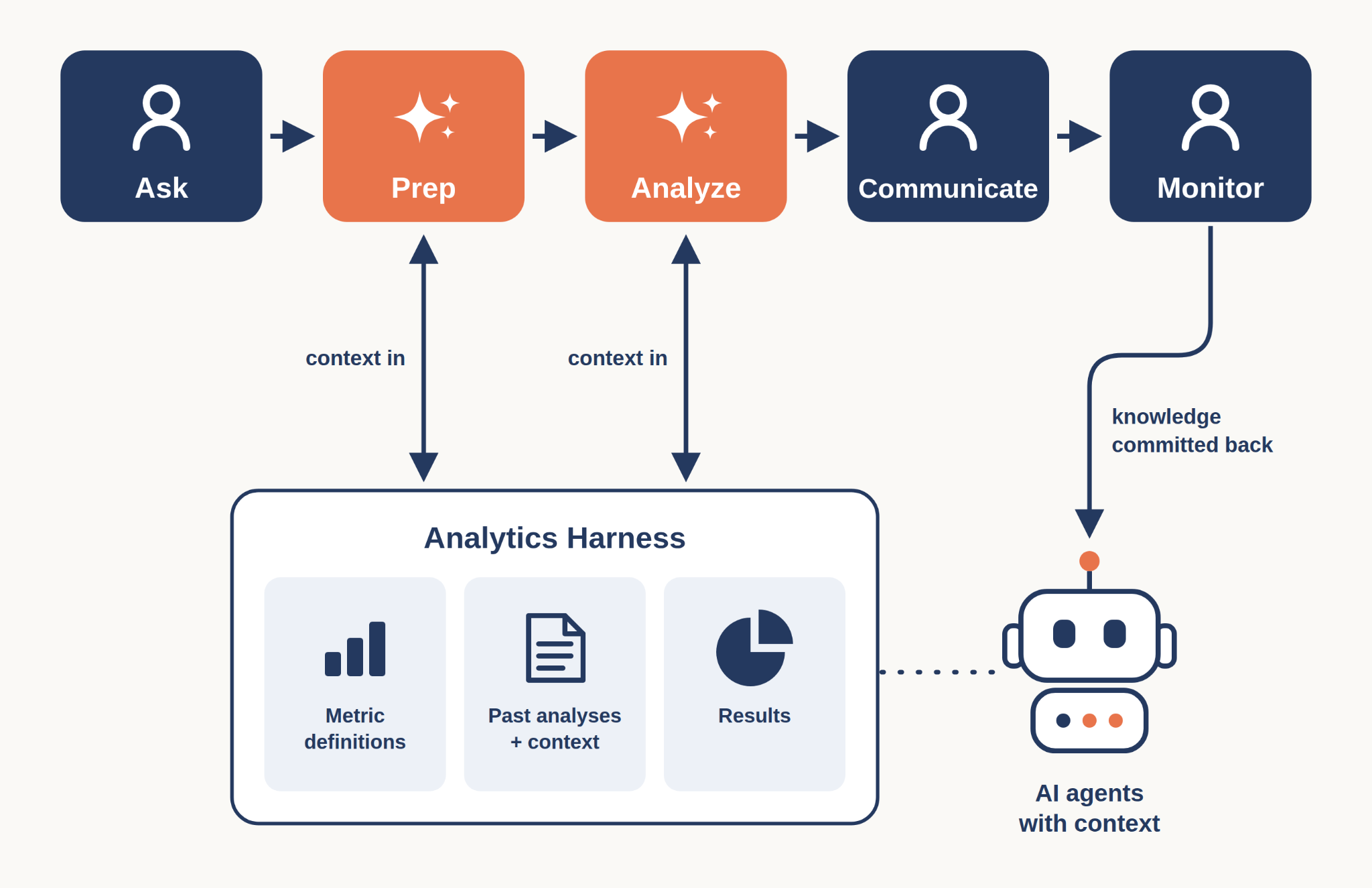
The pattern across the bottlenecks is consistent: what slows AI-assisted analytics down is a lack of context, not a lack of ability. So our biggest bet is to stop letting knowledge live in people’s heads and scattered notebooks, and put it where both humans and AI can use it.
Our approach: an “analytics harness”
An analytics harness is a shared repository that turns everything we do and know into reusable infrastructure over time.
It includes:
- Metric definitions and known pitfalls
- Trusted queries and validated joins
- Prior analyses, including what worked, what did not, and why
- Business decision history
- Write-ups that end in recommendations, not just charts
Just as importantly, it has a maintenance model:
- Analysts commit only peer-reviewed work
- We treat “context quality” as part of the definition of “done”
- The repository grows over time, rather than restarting from scratch with each prompt
When an agent is asked to measure the impact of a checkout change, it does not start from zero. It can see how conversion was defined in prior checkout analyses, what caveats applied, and what the team concluded.
Instead of each analyst re-explaining the business to a model in every session, the explanation compounds over time.
How this approach redefines good analyst work
Every committed analysis now does a double duty:
- It answers today’s question
- It makes future AI-assisted analysis sharper and safer
Building a reliable source of truth stops being an individual habit and becomes shared infrastructure.
This is not a silver bullet. A repository cannot sign off on results, own a business problem, or decide what is worth analyzing. Accountability stays with people. If anything, it grows.
Instead, it targets the parts of the bottleneck that can be engineered away, so analysts can spend their time on the parts that can’t.
If you’re a Data Analytics candidate: what GetYourGuide is looking for
If your mental model of the job is “write great SQL quickly,” the way we use AI here will change your center of gravity. The analysts who will thrive are the ones who can:
- Frame problems: turn a vague question into a decision, a metric, and a method
- Defend definitions: explain how a metric is built, what it misses, and when it breaks
- Audit and QA: spot failure modes in others’ work
- Communicate with conviction: land a recommendation people can act on
- Stay curious: keep learning tools, methods, and the product itself
If that sounds like your kind of work, you’ll have more leverage, not less. Check out this blog post for tips on how to nail your Data Analytics interview.
FAQ about AI and data analytics at GetYourGuide
What is an analytics harness?
A shared repository that turns good analysis into reusable infrastructure, metric definitions, trusted queries, prior write-ups, and decision history that both people and AI agents can draw on instead of starting from zero each time.
Will AI replace data analysts at GetYourGuide?
No. AI is compressing the technical, code-heavy parts of the job, but the parts that are growing, business ownership, accountability, and judgment, are things a repository or a model can’t take on.
What skills matter most for a Data Analyst role now?
Framing problems, defending metric definitions, auditing and QA, communicating a recommendation with conviction, and staying curious about new tools and methods.
Do I need to be a strong coder to succeed here?
Coding still matters, but it’s no longer the main differentiator. The analysts who thrive combine technical fluency with strong business judgment and accountability for their conclusions.
Closing takeaways
Things are moving fast. In fact, within the time it took to write this blog post, so much changed that we added new sections, built new concepts, and dropped old ones.
Harnesses went from a nice idea to a necessary building block of every LLM implementation strategy. Non-technical colleagues started exploring use cases we couldn’t have imagined working on just a few months ago, and new models opened the door to possibilities we have yet to capture fully.
And more change is coming. In a world where model independence will be a core part of AI strategy, and token prices are expected to rise in the near future, every Data Analyst’s core skill will be staying up to date and curious.
If you’re already curious about joining our team, click here to explore our open roles.
{{divider}}
Thanks to all the GetYourGuide Analysts who pioneered this change, especially Alessandro Artorelli for driving this initiative.

More articles like this

%202.JPG)